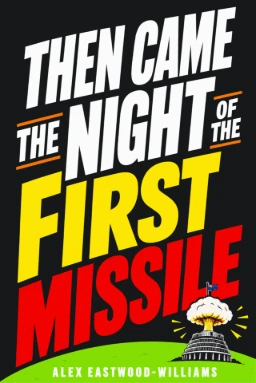
Then Came the Night of the First Missile
Available December 1st 2026
Then Came the Night of the First Missile
DISCLAIMER: This sample is from an earlier draft of the novel and may not fully match the finished product.
Chapter One:
90 SECONDS TO MIDNIGHT
A screaming came across the sky.
Actually, it was more of a yelling than a screaming—an angry, raucous, polyglottal yelling that slowly drifted westward over Midtown Manhattan from its origin point near the intersection of 1st Avenue and 42nd Street.
Invisibly, the yelling made its way down 42nd Street, now barely audible over the sound of honking car horns and a construction worker’s jackhammer.
Even if the yelling could be heard clearly, supernatural listening skills would have been required to successfully parse it as the sound of 193 delegates simultaneously saying “Oh fuck, we’re all going to die” in a multitude of languages, which were all then further translated into one of the six official UN languages as per the terms of UN Resolution 68/268.
Inside the General Assembly, the sound of the yelling was deafening.
The Secretary-General, feeling less like a powerful global figure and more like a schoolteacher defeated by an obstreperous class of kindergarteners, tried to no avail to call the delegates to order.
Even the translators, to whom she had a direct microphone feed, struggled to hear her flat New Zealand vowels begging for order. Over and over again she tried to silence the panicking delegates until finally giving up when her larynx succumbed to the strain of so much yelling.
She curled over her desk, face buried in her hands, choosing to ignore the pandemonium breaking out in front of her. A paper dart flew across the room, made from the draft text of the failed resolution she had hoped would prevent growing geopolitical tensions from ending life on earth as we know it.
She had failed.
They had all failed.
And now the consequence of her failure was hurtling toward her through the edge of space, just above the earth’s atmosphere, at a speed somewhere between Mach 15 and Mach 23.
In less than 30 minutes, it would re-enter the atmosphere just above New York City and begin a chain reaction that, she hoped, would vaporise her instantly and painlessly. Alternatively, she would soon be burned horribly in a fireball or perhaps ripped limb from limb by a shock wave of extremely high air pressure.
Even in that scenario, she was one of the lucky ones. Out in the suburbs, anyone who survived was facing a truly unenviable future involving trying to survive without food, water or electricity. And even if they found a way to meet their basic needs, the chances of them contracting cancer or radiation sickness would be so high as to become almost inevitable—and all this would be in a world without advanced medical care.
Depending on exactly which warhead was en route, it was likely that people as far afield as Stamford, Connecticut were about to experience having all the skin on their bodies burned off while they’re still alive.
And therein, she realised, was the worst injustice of it all: At least she could claim some culpability, however small. She had presided over failed negotiations, she was the figurehead of a toothless organisation that had proved itself useless in preventing the third world war.
And yet here she was, likely to get away with a quick and painless death, while an innocent schoolteacher somewhere in Yonkers was right now blissfully unaware that her life was about to end in perhaps the most excruciatingly painful way possible and for absolutely no good reason.
She stifled a laugh as she counted the number of delegates who were desperately praying to gods that were, at best, non-existent and at worst actively and provably malevolent.
Another scuffle had broken out in the far corner of the chamber and predictably it involved the ambassador from Israel and another ambassador from somewhere in the Middle East. In the middle, the Permanent Observer from the Holy See held them apart, desperately cajoling them both to repent and turn to Christ, while the Middle Eastern delegate, nursing a black eye of unknown origin, was himself exhorting the others to recite the Islamic Shahada before death or face the wrath of Allah.
There were tears, there was anger, there were a few punches thrown and finally there was laughter, when all three men looked at each other and themselves, with their fancy hats, their crosses and their weird rituals and realised how utterly ridiculous their lives had hitherto been, placing faith in such obviously man-made religious ideologies.
They had less than half an hour to live and only now realised that the thing they wanted more than anything else before they were snuffed out of existence forever was to eat a plate of bacon and/or get laid.
Back at her desk, the Secretary-General turned to her deputy who was himself a picture of stoic calm in the face of the craziness before them.
“Hey Mbwana... I just wanted you to know how much I’ve truly respected you over the years. I don’t just mean that as an empty diplomatic statement either: I truly mean it,” she said.
The Deputy Secretary-General to the United Nations smiled.
“I feel much the same way about you. I am so sorry that it has come to this, that it must all end like this and that we must die here and now.”
“Would you like to get under the table with me?” asked the Secretary-General.
“Madam, I do not expect that the table will provide us with any additional protection when the missile’s warhead detonates. We will all be vaporised whether or not we get under the table and so I choose to face my fate without fear.”
“I wasn’t talking about shielding us from the blast,” she said as she began to unbutton her blouse. “I wanted to know if you’d be willing to fuck me under the table, right now? I know it’s weird, but knowing I’m about to die is making me horny as hell. Maybe being doomed is desperately triggering my reproductive urges in a last-ditch attempt to continue the species, but whatever the reason, I really wanna be fucked, just one last time...”
“You have a husband, Madam. And I have a wife.”
“And you think that’s going to matter in 20 minutes? I have a pussy. You have a cock. The human experiment has amounted to nothing. We’re just animals with the ability to know that we will die one day and that’s all. So why don’t we enjoy ourselves? Why don’t we let our erotic desires triumph over our Thanatotic urges for just this once?”
The Deputy sighed and for a moment she thought he really did intend to go to his grave abstinently, for principles that had already revealed themselves to be arbitrary and meaningless.
But then Mbwana crouched down and gestured for her to get under the desk.
“Before we begin,” he said, “I should warn you that I am HIV positive.”
The Secretary-General snorted. “Like that fucking matters now?”
* * *
The door to the Oval Office burst open and in marched Special Agent Stephen Howard of the Secret Service, flanked by Rear Admiral Andrew Samuels, Military Aide to the President of the United States.
“Madam President, we need to get you to safety!” said Howard. “There is a nuclear missile en route to Washington. Estimated fifteen minutes until impact.”
President Maria Gomez blinked at him.
“Am I not safe here?” she looked from Howard to Samuels. “I thought we wiped out the enemy’s nuclear capabilities, did we not?”
“The Russians have responded to our counterforce plan with a countervalue strategy,” said Samuels.
“In English?”
“We warned you about this scenario, remember?” said Samuels, glancing at the three empty margarita glasses sat atop the Resolute desk. “Russian defence doctrine has always included a countervalue plan—in other words, attacking civilians and civilian infrastructure.”
“But what’s that got to do with me? I’m not a civilian!”
Special Agent Howard shifted nervously on his feet. “Listen, we’re wasting time—we already don’t have enough time to get you to Whisper Mountain but if we can get you into Air Force One we might be able to ride this out with a mobile command unit.”
“I’m not going anywhere! I’ll go to the basement if I have to, but I’m not leaving the White House!”
Howard gritted his teeth. “Madam President, the protocols are very clear. You need to comply with instructions from the Secret Service, so we can get you to safety and ensure continuation of governance.”
“Suck a dick!” said the President, her speech slurring slightly. “Like I said, we’ve won the war already, right? You said that if we did a counterforce... thingy... then China and Russia can’t nuke us any more. So what’s the worry?”
“Madam President... as was explained to you previously in great detail,” Rear Admiral Samuels spoke the last sentence through his teeth, “sending out missiles would no doubt trigger a warning system on their end. Allowing them to respond.”
“Yeah, so, you said they’ll respond with a counterforce attack of their own. So what? A few cornfields in the Midwest get nuked—big deal, most of those states didn’t even vote for me!”
“No, what we said was that they’ll probably respond by attacking our nuclear capability. We also warned that they, particularly the Russians, might go straight for our population centres in a planned countervalue attack.”
“Okay, fine. What are our options?” said the President, casting her eye sideways at Anton Jackson, her Director of Strategy and Special Counsel, who himself had a partly empty bottle of tequila in hand.
“Well, like I said... we need you out of here, stat, right away, in the air,” said Howard.
“Not happening,” said Gomez. “I’m willing to go down to the bunker if you want, but I’m staying in Washington. I want to look strong, I don’t want the American people seeing me running away.”
“The bunker won’t protect you if there’s a direct hit,” said Howard. “We need to get you airborne and away from Washington ASAP!”
“How likely is it that there’ll be a direct hit?” slurred Anton Jackson, piping up for the first time.
“It’s almost inevitable. I’ll be surprised if they don’t intend to use the White House as Ground Zero,” said Howard. “Which is why you need to move! Now!”
“I’m staying,” said Gomez. “That’s final.”
“Good call, Madam President,” said Jackson, raising an empty shot glass sycophantically. “Shows strength. Looks good in the polls. The Republicans won’t stand a chance in the mid-terms now!”
It was taking Stephen Howard every shred of discipline he could muster to stop himself from screaming at the President and her equally brain-dead political advisor.
“Madam President, I don’t think you grasp the true magnitude of the situation we’re in,” he said, at this point literally biting his tongue. “It’s not my job to comment on politics but at this rate there won’t be mid-terms, there won’t be elections, there won’t be an America or anyone left to vote for you! Now please, for the love of God, would you come with me, we’ve probably got less than ten minutes left to get you into the air!”
This time he’d gone too far and President Gomez stood. What she lacked in stature she more than made up for in her ability to intimidate people twice her size. Any trace of amicability had been wiped clean and replaced with her trademark death-stare, the one that had terrified countless debate opponents into submission.
“Do you know how hard I had to work to make it into this office?” she spat. “Do you know the things I had to do to get here? To get into the White House?”
“Madam President this is—”
She waved his protests away and stepped toward him, her face twitching with barely repressed fury. “Do you know what it means to be a woman in this place, Mr. Howard? Not just that, do you know what it means to be a woman of colour? Do you know what it means that a woman of colour made it to the White House?”
“Madam President, I am not in any way denying the historical importance of your election, but that is not even remotely—”
She glanced at Jackson, who nodded supportively at her and motioned for her to continue her tirade.
“Do you understand what message it sends to millions of American women if I run away right now? It says ‘The men were right. Women are weak. Women aren’t fit to lead America through war and crisis.’
“Do you know what message it sends to millions of minorities, struggling each and every day against prejudice, to see one of their own running away to safety while abandoning them all to their doom?”
Howard shrugged. “I’m just following the protocols, Madam President. If you choose to make a noble or heroic sacrifice for your principles, then perhaps we should consider invoking Article 25 of—”
“I didn’t say anything about sacrifice!” she barked. “This is about showing strength! No one believed I could make it to the White House! Now I have you, another white male, telling me that you don’t believe that I can survive a direct hit by a nuclear missile!
“Well when I prove you wrong, yet again, the American people—the survivors, they’ll remember it when they go to vote. And they’ll remember that anything is possible no matter what your race or your gender identity might be!”
The Director of Strategy jumped to his feet and began clapping loudly. “You tell him, Maria! That’s why you’re the President! More than a President—you’re a Queen, girl!”
“Okay fine,” said Howard, turning for the exit. “You wanna die, fuck it. Your call. I’m done trying to reason with you. And if we do survive... fuck democracy, it’s failed.”
He slammed the door behind him, leaving Rear Admiral Samuels still standing silently in the middle of the room, clutching the nuclear football.
President Gomez scowled. “What the hell are you still doing here?”
“We need to know your orders, Madam President.”
“What?”
“Do you want to respond to the Russian countervalue strike with a countervalue strike of our own?”
“I don’t know,” the President looked to her Special Counsel. “Do I?”
“Permission to speak frankly, Madam President?” said Samuels.
Gomez rolled her eyes and gestured for him to continue.
“Madam President, I want you to know that by targeting population centres, you’ll kill tens of millions of people. Innocent people, this time. Civilians... the elderly... children... people with no ties to the war or to the Russian and Chinese regimes.
“I know I shouldn’t venture my own opinion, but were you to ask for it I would tell you not to launch a countervalue strike for the sake of humanity. It will achieve no military objective—all it does is prolong and deepen the suffering of any survivors and make human extinction more likely.”
“Mmm...” said Gomez. “Well I thank you for your opinion, Rear Admiral. What do you think, Anton?”
“I think you’ve forgotten we have the mid-terms in November, Madam President!” said Jackson, rising to his feet. “If you let them get away with nuking us without retaliation, you’ll look weak. Any surviving Republicans will crucify you in the polls for that! I say an eye for an eye! Remind them how strong and decisive you are!”
“Madam President, I strongly disagree with Mr Jackson’s advice here,” said Samuels. “Do you really want to kill millions of innocent people just to win an election that probably won’t even happen? The chances of you surviving the incoming strike are negligible. Are tens of millions of innocent lives really worth something as trivial as this?”
Gomez paused and for a brief and beautiful moment her military aide suspected that perhaps her sense of human decency had prevailed.
The moment was short-lived.
“Well, Rear Admiral,” she snarled. “If I’d listened to people like you, I wouldn’t be the President right now! Order the countervalue strike! Kill them all, I don’t give a fuck! I’m a strong, independent woman and I don’t need advice from some crusty old white guy in the navy!”
“Great choice, Madam President,” said Jackson, applauding. “You know how to slay them!”
“Thanks,” she said. “Now where’s the button? I can’t believe I actually get to press the red button!”
“There’s no red button, Madam President. Remember when you launched the counterforce attack?”
“Urgh,” said Gomez. “See... that’s the worst part about all of this! It’s not the death, it’s not the destruction, it’s not even the weight of responsibility that makes me sad... it’s the fact that I don’t even get to press a red button! That’s supposed to be the main perk of being President and I don’t even get to do it...”
* * *
At City Hall, New York mayor Michael Santori first learned of his incoming doom not from any official source but through a very rapid explosion of rumours on social media.
“Look at this, Mark—” he said, holding his phone up for the chairman of the Chamber of Commerce. “Every major network is saying that the war has begun... and that if it hasn’t gone nuclear already, it’s about to.”
Marcus Hartigan snorted as he cast a disdainful eye over the mayor’s Twitter feed.
“You believe those idiots?” he said, adding with a sardonic smirk, “Those are the same bozos who accused you and me of having some kind of inappropriate business relationship!”
“Well I mean, they weren’t wrong about us having a financial relation—”
“I never said they were wrong about that! I meant they were wrong about it being inappropriate. This is America, for god’s sake! Those damn communists in the mainstream media seem to think they have a right to stick their noses into every instance of a free transaction between consenting adults! For what? Yeah, I gave your campaign a few dollars and yeah, maybe you gave me something in return and maybe you didn’t... it’s still a free country last time I checked!”
“I dunno, Mark, I think this could be serious.” Mayor Santori pulled his feet off the desk and sat upright. “I don’t think the Russians were joking about bombing Europe.”
“Of course they were. They always bluff. If you play Russian roulette against a Russian, they leave every chamber of the gun empty! That Patruchev guy’s all talk—talk is all Russia’s got now.”
“Okay, but what about what’s going on with China and Taiwan? That’s not a bluff!”
Hartigan shrugged. “None of our business. Why should Americans fight and die for a country that we don’t even legally recognise?”
“But we are doing that! Even if they don’t officially say we’re at war with China, we’re very clearly at war!”
“You’re stressing out too much, Mr. Mayor. This is for Washington to figure out. Focus on New York! Wall Street’s taken a massive hit since the Democrats took the White House—you can turn that around, you know!”
“Well that’s the next problem—Washington! I don’t wanna speak ill of the President—” His broad smirk suggested he wanted very much to speak ill of the President “—but I think she’s mentally unstable! No really, I’m not exaggerating. I wasn’t a big Trump guy but even he didn’t fly off the rails half as much as she does. And he was clinically insane!”
“She’s a product of her surroundings. She went to colleges that teach that everything’s subjective. You raise a whole generation on those ideas and you’re eventually gonna end up with a postmodern president who believes that the concept of sanity is a social construct designed to oppress minorities.”
“And you think it’s a good idea to have someone like that with the power to launch a nuclear strike at will?”
“Of course not,” said Hartigan. “You know I didn’t vote for her. I didn’t vote for either of them—I’m a Libertarian!”
“A Libertarian? In other words, you’re a Republican in denial?” said Santori.
“Hey I still voted for you, didn’t I?” Hartigan guffawed loudly. “Say... who do you think’s more insane? Maria Gomez or Dimitri Patruchev?”
“Definitely Patruchev,” said Santori. “You’ve seen the protests in Moscow. He knows he’s about to be overthrown, probably jailed, possibly killed, so he’s holding the entire world to ransom. And I think he’s insane enough to follow through with his threats. Honestly though, I think they’re all nuts: Patruchev, Gomez, Zhishang, Chen, the Ayatollahs, that North Korean guy...
“What do they all have in common? They’re sociopaths, each and every one of them. At best sociopaths, maybe full-fledged psychopaths. That’s why these news reports are freaking me out. Someone with no ability to feel empathy, backed into a corner, with access to nuclear weapons... that’s someone who can and will destroy the world!”
The phone on the mayor’s desk buzzed.
Santori sighed. “What is it, Deborah?”
“I have someone from Civil Defence on the line, says it’s urgent.”
“Tell him or her I’ll call back, I’m having my meeting with Mark right now.”
A pause.
“She says she can’t call you back and that you need to pick up right now,” said Deborah.
Santori rolled his eyes theatrically for Hartigan. “Alright, patch ‘em through.”
As the mayor took the call, Hartigan used the time to scroll through his Facebook feed, where he noticed there seemed to be a slightly larger than usual cadre of posts about the apocalypse—something he attributed to Facebook’s algorithm, rather than any genuine cause for concern.
When he looked up again, he saw that Santori’s face was now completely white.
“Bad poll results?” said Hartigan. “Someone fuck up?”
Michael Santori’s lip trembled. He tried to speak but the words didn’t come.
“Did something happen to your wife?” Hartigan frowned and leaned forward with genuine concern. “One of your kids?”
“K-kids...” said Santori, his eyes trained on something very far into the distance. “Oh god. The girls! They’ll be... we’ll all be...”
His eyes flashed on Hartigan and he was back in the room. “We’re dead, Mark.”
Hartigan guffawed again. “Well if this is death, then death ain’t so bad, is it?”
“No,” Santori swallowed. “We’ve got maybe fifteen minutes to get to a shelter. The rumours were true! There is a missile headed for New York... it’s on its way right now! Apparently there are hundreds heading for the States as we speak! Most of Europe is already gone...”
Hartigan checked his watch. “You’re a few months late for April Fool’s, Mr. Mayor...”
“I’m serious!” Santori’s voice squeaked with panic. “The alarm! There needs to be an alarm. A siren... a mass text message... a... something!”
“Get a hold of yourself!” said Hartigan, standing and grabbing the Mayor by the shoulders. “That’s not at all what we should do! If you panic, the markets panic. Think about it! Think about how much money you and I have invested in the stock market... if people think there’s a nuclear missile coming, they’re not gonna wanna invest are they? And what’s that gonna do to the value of our stocks?”
“Mark... what are you talking about?” said Santori. “Didn’t you hear me? We’re going to die!”
“No we’re not,” said Mark. “We’re gonna survive. You and me, underground, we’ll ride this thing out. And you know what’s gonna happen when we’re given the all clear? We’ll cash in our investments, that’s what! We’ll be rich, Mike—err, I mean... Mr. Mayor—rich beyond our wildest dreams!”
“So what are you saying, Mark? That I shouldn’t warn New Yorkers to get to the public shelters? That I should let business continue as usual?”
Hartigan sighed and sat back in his chair. “Look—here’s the way I see it. People who wanna go to shelters are gonna go to shelters. People who are worried about nuclear war probably already have plans of their own! And it’s a free media out there so it’s not like no one’s gonna hear about it, right?”
“But they need leadership—”
“No. This is a democracy! We don’t need leaders, we rule ourselves! We let individuals make choices and we are not gonna have big government fuck it all up by telling people what to do. Let the people decide!”
“Hmmm...”
“Mr. Mayor, as the head of the Chamber of Commerce, I think I speak on behalf of every single business leader in this city when I say—we don’t need you causing a panic! You’ve done the best you can to prepare people for nuclear war.
“It’s New York, crazy shit happens in New York, it’s not like anyone will be surprised that we’re a nuclear target! But let me tell you: Small grocery store owners don’t need panic shoppers, they don’t need looters! And Wall Street doesn’t need news of impending destruction to cause the Dow Jones or the Nasdaq to plummet!
“You talked about showing leadership? This is leadership! It’s about keeping a cool head, going about business as normal and then you go down to the shelter in your own time, calm and dignified. You can’t let the cure be worse than the disease! Yes, a nuclear war is a challenge, but it’s still no reason to place unnecessary restrictions on business!”
Mayor Santori turned and looked out the window, knowing it was the last time he’d ever see Manhattan as he recognised it—assuming he even lived through the next few days at all.
He sighed.
“You know what, Mark? You’re right. I believe in people. I believe in freedom. Let’s not cause a panic, let’s just continue as if nothing had ever happened.
“Shall we continue this discussion in the fallout shelter?”
* * *
Nate Jones muted his television, tired of the incessant shouting of the talking heads and various cable news presenters, all desperately digging through the most minute of details in the vain hope that they might find a unique enough take on the incoming nuclear catastrophe to win the final ratings war.
His eyes were focussed on the bottom of the screen, at the ticker of breaking news information scrolling past. Occasionally his eyes flicked to the low-cut blouse of one of the network’s more attractive female presenters—he couldn’t help it, but he was determined not to let all this commotion about war distract him from what was really important right now: The baseball scores.
After a minute he gave up and decided to just look them up manually on his phone. He picked it up off the coffee table and glanced down to see that someone was trying to call him—an unknown number. Probably a friend or family member wanting to say goodbye—he concluded he could spare them one minute of his remaining ten, as long as they didn’t talk his ear off.
“Nathan Jones,” he said by way of greeting.
“Mr. Jones!”
Nate couldn’t quite place the voice. It was male, young—maybe someone in his 20s, vaguely familiar, slightly desperate.
“Who is this?” he asked.
“This is James,” said the voice, “Err, James White that is! Look you probably don’t remember me, but—”
Nate scrunched up his face. James wasn’t wrong—he didn’t remember him although there was definitely something familiar about the name and the voice.
“—fifteen years ago we worked together. You were my boss at Edwards and Jones Insurance... I was just an entry-level clerk back then.”
“Ah yes...” said Nate as the distant memories swam slowly back into focus. He still couldn’t quite picture James, but he vaguely remembered there being a “James” among a group of young recruits from that time period. “Well James, this is very unexpected, especially now. What can I do for you?”
“I know we don’t have long left on this earth but now that I’m facing my doom, I’m realising what’s truly important in life and I just wanted to apologise.”
“Apologise?”
“Yeah. Fifteen years ago you asked me to stay and work overtime one night and I told you I couldn’t because my wife was pregnant and I wanted to be there when my kid was born. But I realise now how stupid and selfish I was to do that.
“Having loved ones doesn’t pay the bills. Having a job does. You were the one who was paying me back then and I should have been more grateful. All you wanted back then was for me to spend an extra two hours updating our client files but I couldn’t even give you that and I just want you to know that the guilt has torn me up inside ever since then. I’ve not been able to properly look myself in the mirror since.”
“Well James, I...” Nate had only the vaguest idea of what James was talking about. “I can assure you that you’re forgiven. I think we only live once and you were right to spend that time with your loved ones, and not at work.”
“Thank you sir, your forgiveness means a lot to me,” said James. “But I just want you to know, although we have maybe eight minutes left to live now, and although you have forgiven me, I still will never ever be able to forgive myself for putting something as meaningless as family ahead of my entry-level job.”
Nate heard James’s voice break in the final few words, clearly choking back tears, and then the line went dead.
He took a few minutes to reflect on the conversation he’d just had, about what was truly important in life and what really matters.
“Nathan!” His wife’s voice came echoing down the stairs as she ran into the living room, tears in her eyes at the news of the incoming missile. “We don’t have long to live. Can we please video call the children one last time? I want to see my grandchildren. I want to tell them how much I, how much we both, love them before... b-before it happens.”
“I’m not stopping you,” said Nate. “But... here’s the thing, I have only seven minutes left on this planet before I stop existing forever and I don’t want to waste it. If you wanna talk to the family that’s on you, but I’m gonna use the last five minutes to write up a proposal on how to make the business more efficient.
“I might not benefit from it myself, but if there are any survivors after this nuclear war, you can bet they’ll be grateful that I spent this time figuring out how to reduce overhead expenditure instead of wasting it saying ‘I love you’ to people who probably already know that by now.”
His wife scowled and then stopped, realising Nate’s logic was sound.
“You’re right, Nate, we shouldn’t waste our final minutes,” she said. “Fuck the grandchildren! I’ve got five minutes left to watch as much reality TV as I possibly can!”
* * *
The first missile was greeted not with terror or fear, but by thousands of people all aged below thirty, craning their smartphone cameras skyward to catch a glimpse of it as it hurtled toward them with its nuclear warhead soon to detonate.
The servers at Instagram, TikTok and Twitter strained to maintain the bandwidth of millions of users simultaneously livestreaming their atomic deaths. Doomed teenage girls posted selfies with the missile almost visible in the background, hastily uploaded with the hashtag #Goodbye.
Inside the missile, a small explosion began a chain reaction causing weaponised uranium to reach critical mass and explode into a burning white light, the same brightness and temperature as the surface of the sun, vaporising millions of denizens of one of mankind’s greatest cities in a near instant and leaving millions more to a slow, agonising death over the next few days.
The livestreams all showed people clapping and cheering, desperate not to show any sincere emotion or fear for their followers (because it might upset the algorithm), as a bright ball of light engulfed them on screen, melting their devices into their skin before melting them away altogether. Followers of those who streamed with particularly advanced phones were privileged to see brief images of people’s skin peeling off their bones in the dazzling light while others chose to use the moment of the nuclear explosion to broadcast one last copied-and-pasted quote about the power of positive thinking.
At least a million, and perhaps more, social media users suddenly vanished at that moment—they saw the light and then everything they were became darkness, as if they had never been born.
But there were no regrets, because deep down they all knew that it’s not life that matters—what really matters is how many likes you can get.
Chapter Two
THE DAY AFTER
“... it’s impossible to know the exact number, but it’s currently estimated that 91 million people have died as a direct result of the nuclear conflict with billions more now facing an excruciating and desperate fight for survival. We now cross live to atomic warfare expert Dr. Sylvia Fitzgerald and All Blacks coach Greg McKenzie for their reactions.
“Greg, I’m gonna start with you—the All Blacks were due to travel to Ireland next month for the Rugby World Cup. Do you think that global nuclear annihilation is likely to have any impact on the team’s chances in the tournament?”
— “Oh look, Jim, you know I don’t like to speculate on these matters, at the end of the day my job is to ensure that every player’s at the top of his game and prepared for anything. I won’t be making any assumptions.”
— “Is the World Cup still going ahead? Several rugby nations have received direct hits with atomic weapons, which may well have taken the lives of key players. Has there been any word from the International Rugby Board?”
— “At this stage no one from the IRB has returned our calls so I’m assuming that means the World Cup is still going ahead. Look, it might not draw the crowds we were hoping for and yeah there are serious discussions going on about whether the boys might need to play in hazmat suits because of the radiation and nuclear fallout, but... these are all decisions we’ll be making in due time.”
— “Dr. Fitzgerald, what’s your take on the events of the last 24 hours?”
— “Well Jim this is a phenomenal tragedy, I don’t think any aspect of life in New Zealand or anywhere else in the world will be the same ever again. This is the end of civilisation as we know it.”
— “Sorry, I specifically meant in the context of the Rugby World Cup. Ireland is due to host, they’re very close to Great Britain who have been the target of multiple direct strikes. How’s that likely to affect them in terms of things like wind patterns and do you think that they’ll be in any state to continue hosting the World Cup?”
— “To be honest, Jim, I don’t think the World Cup is likely to be Ireland’s number one priority right now. We don’t have much information about the location of the attacks on Great Britain or the size of the bombs dropped, but it’s safe to assume that a significant amount of radioactive fallout will drift across the Irish Sea and cause serious damage to that country’s infrastructure.”
— “Do you think then that it might be a good idea for Australia or New Zealand to take over hosting responsibilities instead, in light of this disaster?”
— “I really don’t think this is the most important question of—”
— “Yes or no, Dr. Fitzgerald? Is Ireland still in a fit state to host the Rugby World Cup?”
— “Well, in light of what’s happened... I suppose the answer would be no.”
— “Okay well there we have it! An endorsement from an expert in nuclear warfare to move the Rugby World Cup to New Zealand!”
— “Jim, there’s so much more to discuss than—”
— “Thank you both for your time, but I’m afraid I need to move on to our other top story this evening:
“Thousands of farmers descended upon the steps of Parliament this afternoon to protest a controversial new law which would regulate the use of sheep-drenching. Several of the government’s own MPs have threatened to vote down the controversial bill, leaving the Prime Minister in a particularly precarious—”
* * *
The New Zealand Cabinet Office, located on the top floor of the Executive Wing of Parliament (better known as “The Beehive”), is a room that, at the best of times, has all the warmth and charm of a cartoon super-villain's lair—albeit a supervillain with a fetish for tacky modernism and bland, sterile office spaces.
The room looked even more ominous than usual on the day Cabinet met to discuss the impact of the ongoing nuclear war, as thanks to several malfunctioning fluorescent tubes and recent industrial action by Parliament’s maintenance team, the only light in the room was that which came from adjacent rooms or the glow from people’s smartphone screens.
Because the Cabinet table was circular, there was no discernible “head” of the table or anything in the seating arrangements to distinguish one minister from another. Nevertheless, there was one man at the table who was considered “first among equals”, his special status designated by a flimsy folded piece of paper upon which was printed the words “PRIME MINISTER” in large block capitals.
He stood, his tall and well-built frame appearing only as a darkened silhouette to any Ministers viewing him from the opposite side of the room, and a hush fell over the room as the man who may well now be the sole surviving leader of the free world prepared to deliver possibly the most important speech of his career before New Zealand’s highest decision making body:
“Ugh, yeah, so ugh... yeah... ugh... morning everyone. Ugh...” He paused and wiped a small rivulet of sweat from the back of his neck. “So, um.... bit of news last night. Dunno if you heard. Um. Looks like there’s been a bit of a... um... bit of a nuclear conflict up in the, ugh... up in the northern hemisphere. Lotta casualties and death and... stuff. Ugh. Yeah, it’s, ugh... it’s not looking too good, eh?”
He shifted nervously, unable to return the gaze of his colleagues thanks to the poor lighting in the room. Chris Richardson was many things—a former All Blacks captain, a successful businessman, a popular local celebrity turned politician. But Winston Churchill he wasn’t.
“So ugh... in light of that... ugh... if there are no objections I’m thinking we might need to, you know, make a couple of changes to the agenda today. Given the urgency of the situation and all that...”
There were murmurs. Whispers. Then silence to indicate no objection.
“Alright, so—”
“Hold on, Prime Minister!” The interlocutor was Graeme O’Brien, the Minister of Agriculture. “Before we start talking about this nuclear business... I really think we need to be tackling the main issue facing the country right now because it’s not gonna go away.
“Are we, or are we not, gonna proceed with the new sheep drench regulations? Because the backbenchers aren’t happy, rural voters are fuming... if we go ahead with this, we might never win a rural seat again!”
Richardson nodded. “I hear you loud and clear, and I’m not saying that the sheep-drenching bill isn’t one of our main priorities but we do need to come up with a strategy to deal with—”
“Prime Minister, I don’t want to be rude or for you to think I’m arguing with you, but... even I’m agreeing with the media commentators now. You can’t kick the can down the road forever. We need to know, straight up, yay or nay on the sheep drench regulations?”
“Come on Graeme, get with it man!” said Finance Minister Joseph Ngatuere, leaning as far back in his chair as it would go without snapping. “We can talk about sheep another time. This is literally the end of the world!”
“Thank you Joseph,” said the Prime Minister, to whom Ngatuere returned a glowing, obsequious smile. “Yeah, look, ugh... we’ve gotta be real here, guys. Nuclear war is one of those rare things with a level of urgency that I think surpasses even the question of sheep-drenching.”
“Bloody Aucklanders...” muttered O’Brien before signalling to the others to continue.
“Yeah, ugh, anyway... I was thinking maybe Carol might like to give an update on the international situation?” said Richardson, returning to his seat to give the floor to the stern and square-jawed woman sat across the table from him.
Carol Sutcliffe had originally served in opposition as the party spokeswoman on foreign affairs but luckily for all involved, post election negotiations with minor parties prevented her from ever actually taking the reins at the Ministry of Foreign Affairs.
Instead, as a consolation, she was made Minister of Defence because her husband had a friend whose cousin used to know a guy who mowed lawns on a military base, which by New Zealand standards meant she was practically a war veteran.
Sutcliffe relished her role—in fact her icy stare (or worse yet—her scowl!) could well be said to form a larger and more terrifying deterrence to potential foreign adversaries than anything else in the New Zealand Defence Force’s arsenal.
“Thank you Prime Minister,” she said, her tone perpetually indistinguishable between sarcasm and sincerity. “As I indicated in the memo I sent out last week, the situation in Europe as well as the simultaneous situation in the Taiwan Strait had potential to escalate into a serious and all-out war.
“As it transpires,” The side of her mouth curled ever so slightly into a smirk, “I was right and it’s estimated that 91 million people died last night in the western hemisphere alone as tensions reached critical mass.”
Somebody whistled, impressed by the number.
“All of our overseas diplomats are unaccounted for, and the same is true of nearly a million Kiwi ex-pats.
“Furthermore, I’m very sad to inform the room that our esteemed Minister for Foreign Affairs and Trade—” Once again the inflection in her voice made it impossible to discern whether she was being sincere or sarcastic “—Ms. Awhina Mihi, was in Japan when the North Koreans attacked and is also currently unaccounted for.”
“How terrible,” said Joseph Ngatuere, whose ability to mask sarcasm was notably less developed than that of the Defence Minister.
“Yes... quite,” Sutcliffe continued, flattening her lips so that her mouth became perfectly parallel with her square jaw. “The advice that I have received from the New Zealand Defence Force is that there is a low but not altogether impossible chance that New Zealand may be a target for attack or even invasion and that it might be a good idea to inform and prepare the public for this possibility.”
The Prime Minister leaned forward. “What kind of preparations are they suggesting?”
“The usual things. Upgrade air defence, buy them some new guns... maybe consider conscription or arming the public. Nothing that’s gonna come cheap to the taxpayer.”
“Where the hell are we supposed to get guns and air defence systems from?” said an unidentified minister, shrouded in darkness on the opposite end of the room. “Isn’t America basically gone now?”
“We could ask the gangs if we can borrow some of their guns?” quipped another unidentified minister, drawing a low hum of nervous gallows laughter from the Cabinet.
“Maybe call the museum and see if they’ll lend us some of those old guns from the first world war?” facetiously suggested another.
“Actually, the NZDF seriously suggested that,” said Sutcliffe. “Turn a few screws and fix some of the rust and those old museum pieces are honestly the best artillery we’ve got!”
“Okay, well, I guess at this point it’s a matter of looking prepared, rather than actually being prepared,” said the Prime Minister. “People are gonna panic. They’re gonna be irrational. They don’t need to know that New Zealand’s national defence strategy basically consists of a kite and a pointed stick. They want things to look organised, to look like we’ve been preparing for this for years.
“Ideally, I reckon what we need is for me to go to the media and say to the public that I’ve triggered Operation Such-and-such and that we’re working on how we’re going to get through the next few days, weeks and months. They don’t need to know that Operation Such-and-such is being made up on the fly—as long as it has a cool sounding name, I’m sure we’ll placate the public.”
There were more hums, whispers and murmurs but it ended in nods and a tone that sounded a lot like assent.
“And look,” he continued, “if we can pull this off, then the next election is in the bag! And I’m talking landslide territory! I’m not saying anyone actually needs to do anything but if we look like we are and look like we have a plan then the opposition are gonna be sitting ducks between now and then!”
A smattering of applause followed. Whatever misgivings the party might have had about giving the leadership to an ex-All Black, there was one thing they all agreed on: Chris Richardson knew how to win elections.
“I’d like to move for an emergency budget,” said Ngatuere, suddenly sitting bolt upright. “Make it look like we’re gonna help get people through the tough times. Come up with some feel-good bullshit.”
“What are you thinking, Joe?” said Graeme O’Brien.
“I’ll tell you what I’m thinking,” said Ngatuere, flashing his trademark perfect Hollywood-style grin at the rest of the room, “It rhymes with ‘Flax Huts’.”
“Can we afford tax cuts at the time like this?” said Sharon Turner, one of the government’s more level-headed (and therefore very junior and unpopular) Cabinet Ministers.
“Well,” Joseph Ngatuere said, getting to his feet. “While you’ve been talking, I’ve been doing some calculations on the back of an envelope and I’ve got a pretty good idea of what we can do...”
The room went silent, completely enraptured by a combination of his charisma and his good looks. At 33, Joseph Ngatuere was by far the youngest minister in Cabinet and possibly the youngest Finance Minister in New Zealand history.
But his youth was on his side—as was the fact that he was exceptionally well dressed, tanned and handsome. Polls suggested that his popularity rivalled that of Chris Richardson, thereby making him Richardson’s biggest threat within the party—hence his elevation to such a powerful position at such a young age.
“So what I’m thinking is that we’ll need to subsidise the more, how shall I say it, ‘productive’ members of society through tax rebates... in order to rebuild the economy of course.” He flashed another smile, one so powerful that if he wanted to, he could have suggested building a bridge over Auckland harbour entirely out of cheese and half the Cabinet would have dreamily approved it. “You see, we’re going to run out of key resources quite quickly: Fuel, metals... pretty much anything other than milk, as far as I see it.”
“How is a tax cut going to help with that?” said Turner again, who seemed to have temporarily slipped out from under Ngatuere’s spell and reconnected with her prefrontal cortex.
“It isn’t!” said Ngatuere. “But that’s the beauty of this plan! It looks like we’re doing something but really... money won’t be worth anything in about a year anyway but it’ll give... you know, the right sort of people time to stock up and make sure they’re able to comfortably ride out the apocalypse!
“Here’s my plan: You know that top tax rate? It’s gone! All the people who normally vote for us or donate to us... they’re gonna get a windfall. And we’ll frame it as a rebate rather than a tax cut because otherwise they’ll accuse us of favouring the rich and those optics aren’t great at a time like this.
“But what’s really great about this plan is that as consumer goods become more and more rare and unaffordable, we can pretend we’re stimulating the economy even though we’re actually giving money to the demographic who consume the least, which means that technically it’s a deflationary policy that just so happens to help the people who got us where we are today.”
Ngatuere’s plan wasn’t met so much with applause but by a strange groaning noise that suggested that a large portion of the Cabinet was about to reach sexual climax at the very thought of another tax cut for upper income earners.
“Sounds like you like it?” said Ngatuere, aware that at least one minister had literally started masturbating in the shadows while thinking about cutting taxes for the rich. “Do I have Cabinet’s approval to announce an emergency budget?”
One by one, the assembled Ministers voiced their approval (often in the form of orgasmic moans) until finally it was Chris Richardson’s turn to speak.
“So Prime Minister... sounds like we’re a go, right?” said Ngatuere.
“Hmmm, well, ugh...” It was the part of the job that Richardson hated most. He could handle the mudslinging, the Parliamentary debates, the media scrutiny and all the attention. But having to actually make decisions—especially hard or unpopular ones—well, he just wasn’t cut out for it.
He could feel the eyes of his Cabinet colleagues burning into him, even though he couldn’t see them.
The stone cold icy gaze of Carol Sutcliffe, the charming-but-snakelike grin of Joseph Ngatuere, the no-bullshit scowl of Graeme O’Brien. A rare display of unity among the three Ministers that he knew all desperately wanted his job.
And yet—
“I think I’d like to see a bit more detail before we go ahead with an emergency budget,” he admitted. “I’m not saying it’s a bad policy, I’m just saying... it might get misinterpreted if there isn’t some relief for the low income bracket.”
“Oh here we go again!" snapped O’Brien. “This is just typical Chris Richardson pseudo-leadership! Instead of making a decision, you just keep kicking the can down the road, just like you did with the sheep-drenching regulations! You’re the bloody Prime Minister, Chris! This isn’t rugby and even if it was, if you keep procrastinating like this on every decision we make then we’re never gonna get anything done!”
Richardson’s stomach growled. He hated this kind of conflict and the stress was getting to him physically. He could feel pangs of growing stomach pain.
“Correct me if I’m wrong but is it not the job of government to, you know... govern?” added Sutcliffe with a smirk that bordered on being a full-blown sneer.
Richardson hunched over slightly. His stomach was killing him. He could feel something in his abdomen going south rapidly, violently tearing its way down his lower intestine.
“We’re meant to govern, of course we are, but ugh...” Another sharp pang in his stomach caused him to lose the end of his sentence.
“We’re meant to what?” snapped Sutcliffe. “You’re supposed to be our leader! Do some bloody leading, why don’t you? Maybe try a full sentence!”
“I’m just saying that...” His stomach growled violently again and he could feel that whatever was causing it had just reached the region of his bowels. He clenched his buttocks. “Look I’m really sorry but I need to dash to see the kangaroo salesman.”
Stunned silence followed.
“Prime Minister... ugh... what?” said Ngatuere.
“Sorry, I just really need to... you know, go see a man about a kangaroo. Kinda urgently.”
“I’m sorry Prime Minister, I’m not following,” said Sutcliffe. “Is this a metaphor? Are you saying you have a meeting with the Australian ambassador right now? I don’t follow what you’re trying to...”
The Prime Minister’s stomach growled again, this time with an intensity that Richardson suspected might register somewhere on the Richter scale.
“What I’m saying is—”
But they never found out what the Prime Minister was saying because he suddenly turned and sprinted out of the Cabinet Office, clutching his abdomen.
* * *
The video took nearly 30 minutes to load—and that was only for those lucky enough to get on YouTube while it was still running, because the entire internet seemed to have reverted back to dial-up speed.
The video, only available in 240p because HD or higher was simply out of the question now, showed three skeletal figures standing on a stage next to a large object that had been deliberately covered by a black cloth to obscure it.
The announcer had a female voice—raspy, guttural and desiccated. The video switched to a close up of the three skeletal figures. Had it been closer to October one might have thought they were wearing Halloween costumes.
“Joining us to reveal the new time of the Doomsday Clock, today on August twelfth, two thousand and—” The announcer coughed out the year, it was evident that she was struggling to speak “—are Professor Emeritus John Gerschwitz from the University of Southern California, the last surviving member of the Bulletin’s Science and Security Board—”
The first skeletal figure nodded and smiled a little, revealing blood-stained teeth. His skin was covered in red lesions—it was clear that he was suffering acute radiation poisoning.
“—Dr. Shirley Jacobson, Professor of Astrophysics at Kansas State University and Co-Chair of the League of Female Diabetics, Haemophiliacs and Coeliacs for Global Nuclear Disarmament—”
The second figure could barely be recognised as human, let alone female. Her face was now nothing more than a skull covered in a thin, hairless layer of skin, with bloodshot eyeballs in sunken sockets that moved but did not look capable of seeing anything.
“—and last but not least, Mr. Adrian Skye—musician, peace activist and five-time winner of the ‘Shagger of the Year’ award!”
If you were a fan of the teenage heartthrob, then it wasn’t a pretty sight—his long, luscious hair had fallen out in clumps and though it was his wont to wear odd-coloured contact lenses, the amber discs that covered his irises and pupils today were cataracts caused by radiation.
The raspy voice-over lady continued: “The Science and Security Board of the Bulletin of Atomic Scientists, or at least the surviving quorum thereof, moves the hands of the Doomsday Clock forward in light of the global catastrophe that has taken place over the last 24 hours.
“The clock now stands, for the first time ever, at one second past midnight to indicate that we are now on the other side of the nuclear catastrophe and with an extremely slim, though not altogether hopeless, possibility that the human race may survive long enough to rebuild...”
* * *
“Finally tonight, Jane is here with a look at tomorrow’s weather and it looks like spring won’t be coming at all this year?”
“That’s right, Jim—just when we were all looking forward to finally seeing the back of winter, the recent events in the northern hemisphere are expected to cool global temperatures, and that means here in Aotearoa things will be around 4 degrees below average with very little sunshine thanks to all the dust and soot in the atmosphere.”
“No sunshine? Well that’s nothing we’re not used to here in Auckland, lately...”
“Ha-ha, right you are! Speaking of Auckland, MetService have issued a snow warning for Auckland and Northland for the first time in recorded history, with overnight temperatures also predicted to dip below freezing for the first time ever!
“I’ll tell you everything you need to know, right after the break!”